
Why Boat Seats Turning Pink Happens
If you’ve noticed your boat seats turning pink, you’re dealing with one of the most common and misunderstood problems in marine upholstery. Across South Florida — including Fort Lauderdale, Miami, and Broward County — constant exposure to sun, heat, humidity, and salt accelerates wear on marine vinyl and leads to visible discoloration.
At first, it may look like simple pink stains on boat seats or minor surface staining. But in many cases, this is actually boat vinyl discoloration developing inside the material, not something that can be cleaned off. This is exactly why standard cleaning methods often fail and why the problem becomes more noticeable over time.
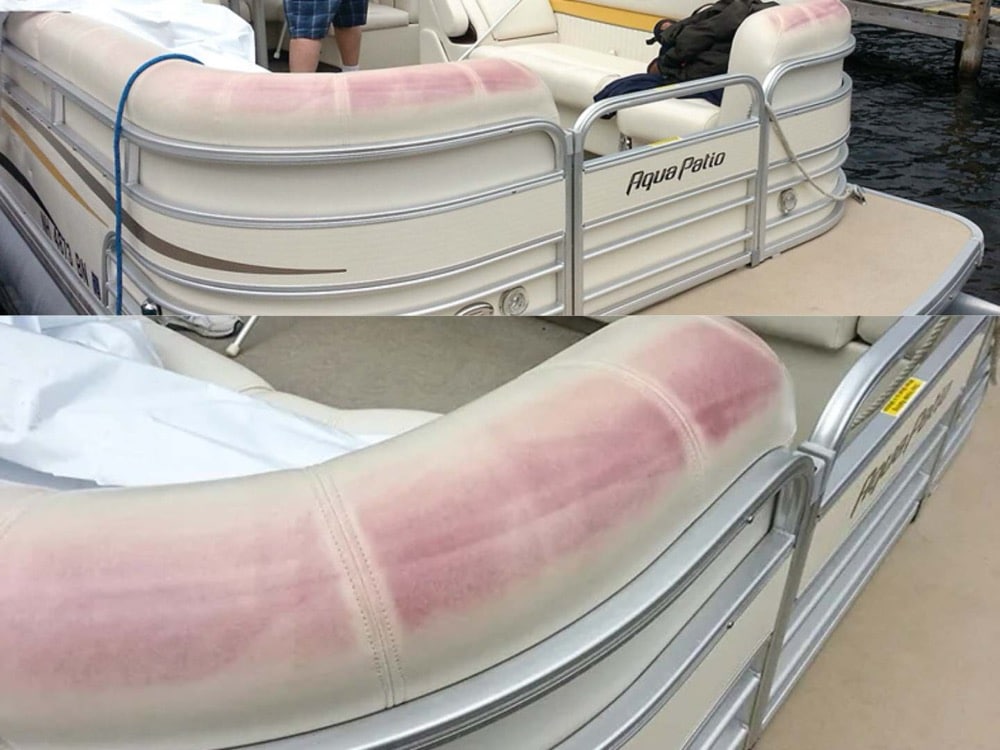
But then something strange happens.
You try to clean it — and nothing works.
That’s where confusion begins.
Some people assume it’s bacteria.
Others blame sun exposure or general wear.
The problem is that while all of these explanations exist, very few clearly explain what is actually happening with pink stains on boat seats.
This leads to wrong decisions:
using aggressive cleaners that damage the material
wasting time trying to remove discoloration that cannot be cleaned
misidentifying the cause of the problem
The key point is simple:
Not all pink stains on boat seats are the same.
There are two different types of discoloration that may look similar but behave differently and require different solutions.
Understanding this difference is what allows you to correctly diagnose the issue and avoid unnecessary damage to your boat upholstery.
Pink Stains on Boat Seats and Marine Vinyl Discoloration
Pink stains on boat seats are often described in different ways — some call it red stains on boat seats, others refer to it as marine vinyl discoloration or vinyl staining. While the appearance may vary, these issues are typically related to how marine vinyl reacts to UV exposure, heat, and external contaminants.
In real-world conditions, especially in Florida, marine vinyl staining is rarely just a surface issue. What looks like simple discoloration is often a deeper material change that affects the durability and appearance of boat seating over time.
Understanding the difference between surface stains and true boat vinyl discoloration is essential for choosing the right solution and avoiding unnecessary damage.
What Are Pink Stains on Boat Seats?
When boat seats are turning pink, what you’re seeing is not always something sitting on the surface.
In many cases, this is boat vinyl discoloration — a change inside the material that affects how it reflects light.
At a glance, these stains may look like:
mildew or mold
– dirt buildup
– sun fading
– chemical residue
But in reality, they fall into two distinct categories:
biological (surface-level contamination)
material-based discoloration inside the vinyl
They may appear similar at first, but they behave differently.
Surface-level stains can sometimes be reduced or removed.
Material discoloration becomes part of the vinyl and does not respond to cleaning.
This is why two boats with similar-looking pink discoloration can require completely different solutions.
Misunderstanding this leads to unnecessary cleaning, wasted time, and additional damage.
Before taking any action, it’s important to identify which type of stain you are dealing with, because that determines the correct approach.
The Two Types of Pink Stains on Boat Seats
When boat seats are turning pink, it’s important to understand that not all stains have the same origin. In practice, most cases fall into one of two categories, and confusing them leads to the wrong solution.
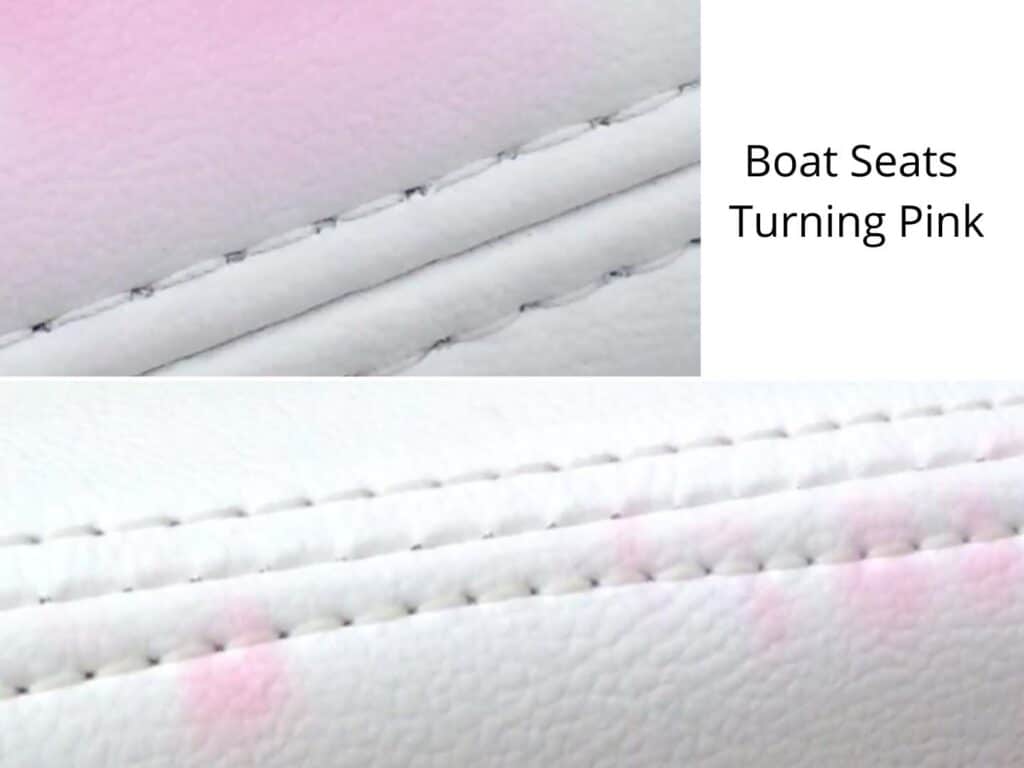
There are two main types of pink stains on boat seats:
biological (bacteria-based)
chemical (material discoloration inside the vinyl)
They may look similar, especially on white or light-colored marine vinyl, but their behavior and causes are different.
Biological staining exists, but it is less common in real marine conditions. In most cases, especially in hot, high-UV environments like South Florida, boat owners are dealing with chemical discoloration of the vinyl.
Understanding this distinction helps determine whether cleaning, treatment, or reupholstery is required.
Biological (Bacteria-Based Stains)
Biological stains are caused by microorganisms that can produce pigmentation, including pink or reddish tones. One of the most commonly referenced bacteria is Serratia marcescens, which is known for creating a pink or red residue in moist environments.
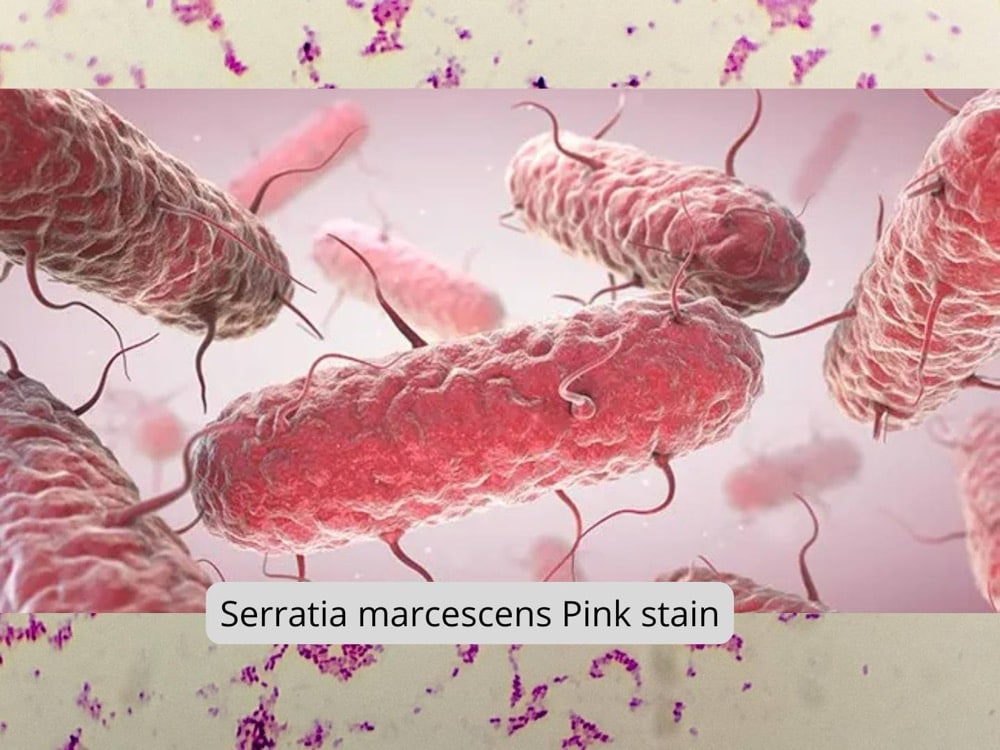
These bacteria typically develop in conditions where moisture remains constant:
shaded areas
poorly ventilated spaces
surfaces that stay damp for long periods
In such cases, discoloration usually appears as:
small spots or clusters
uneven surface film
localized patches without a defined pattern
Bacterial stains are typically surface-level, which means they can often be reduced or partially removed with proper cleaning, especially at an early stage.
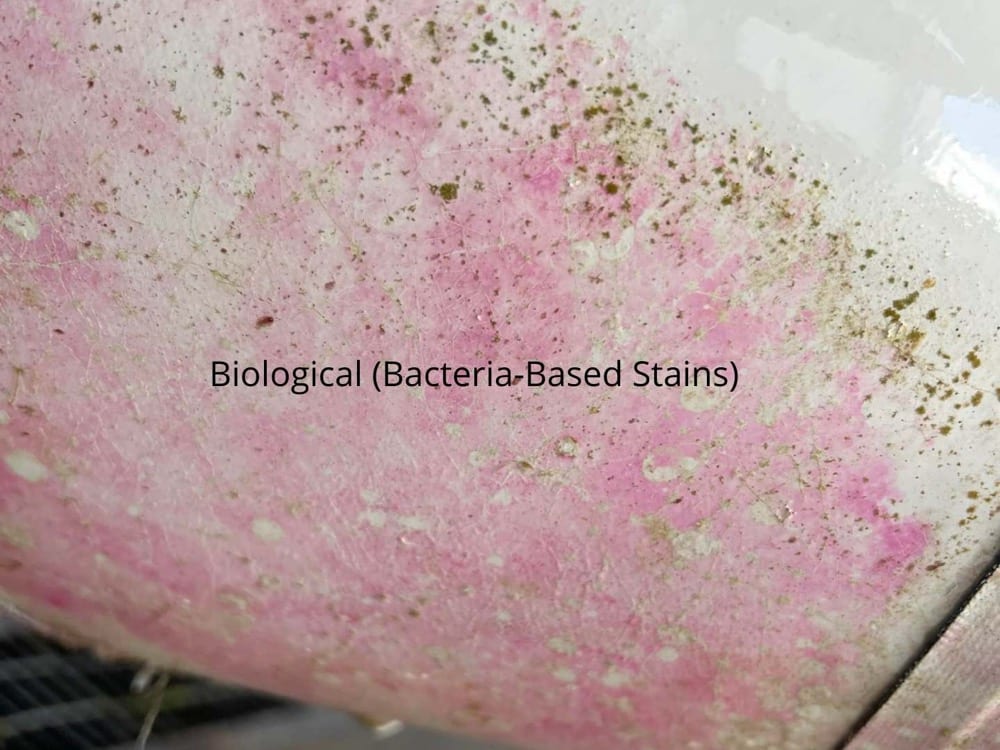
However, this type of staining behaves differently from what is usually observed on boat seats exposed to sun and regular use. If pink discoloration follows the shape of the seating area, appears along seams, or develops gradually in high-contact zones, it is unlikely to be purely biological.
While bacteria can be present in certain conditions, they are not the primary cause in most real-world boat upholstery cases.
Chemical (Material-Based Discoloration)
This is the type of staining most boat owners are actually dealing with when boat seats are turning pink, especially on boats used regularly in sun, heat, and humid environments like South Florida.
Unlike bacterial stains, this is not something sitting on the surface. This is a material-level change happening inside the marine vinyl.
Common contributing factors include:
UV exposure breaking down the protective topcoat
sunscreen and body oils weakening the surface layer
heat making the vinyl more reactive and porous
dye transfer from clothing, towels, and gear
As the protective layer (topcoat) degrades, the material becomes more vulnerable. Pigments from external sources begin to penetrate into the vinyl rather than remaining on the surface.
As a result, the discoloration:
follows seating areas and pressure zones
appears along seams and stitched panels
develops gradually over time
does not respond to cleaning
This is not a surface stain but a structural change in the material.
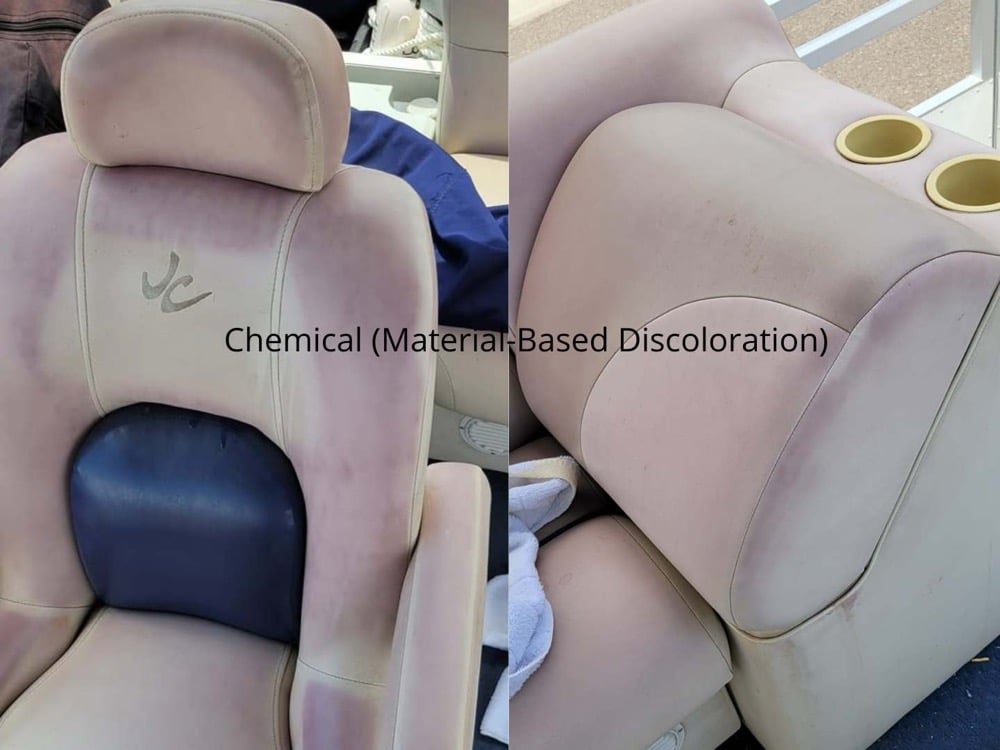
Once this process begins, it cannot be reversed with standard cleaning or detailing methods. The pigment becomes part of the vinyl itself.
This is why this type of boat vinyl discoloration is often mistaken for mold or bacteria, even though its behavior is fundamentally different.
Bacteria vs Chemical Stains — Side-by-Side Comparison
| Feature | Bacterial Stains | Chemical Discoloration |
| Appearance | Spots, clusters, surface film | Smooth discoloration, gradients |
| Pattern | Random, chaotic | Follows seat shape and pressure zones |
| Location | Damp, shaded areas | Sun-exposed seating areas |
| Behavior over time | May spread in patches | Gradually intensifies in the same zones |
| Reaction to cleaning | Can be reduced or removed | Does not respond to cleaning |
| Depth | Surface-level | Inside the vinyl material |
| Cause | Microorganisms (e.g. Serratia) | UV, heat, sunscreen, dye transfer |
| Fix | Cleaning or disinfection | Reupholstery or material replacement |
Understanding this distinction helps avoid incorrect treatment.
If chemical discoloration is treated as a bacterial problem, repeated cleaning will only accelerate material damage.
Correct identification at an early stage allows you to choose the appropriate solution and avoid unnecessary deterioration of the vinyl.
Real-World Pattern: Why Most Boat Seats Turning Pink Is NOT Bacteria
In real marine upholstery work, patterns matter more than assumptions.
When we inspect boat seats that are turning pink, we focus not only on color, but on how the discoloration behaves across the surface. This is where the difference becomes clear.
In most real-world cases, the pink discoloration:
follows the exact shape of the seat
appears in high-contact areas (seat bottoms, edges, bolsters)
becomes more visible along seams and stitching lines
develops gradually rather than appearing randomly
This behavior does not match bacterial growth.
Bacteria do not follow seating patterns or pressure zones. Their distribution is typically irregular and not connected to how the seat is used.
In contrast, what is observed on actual boats — especially in open cockpit areas — directly relates to:
heat exposure
body contact
pressure
repeated use
For example:
front edges of cushions discolor first because of constant seating and movement
bolsters show early signs due to repeated leaning and compression
seams become more affected because they are structural weak points
This leads to a simple diagnostic rule:
If the pink discoloration follows the shape of the seat, it is not bacterial.
This pattern-based approach allows for accurate identification of the cause and helps avoid incorrect treatment that can damage the material.
What Actually Causes Boat Vinyl to Turn Pink
Once it is clear that most cases are not bacterial, the focus shifts to what actually causes this type of discoloration.
The process is not driven by a single factor but by a combination of conditions acting over time.
1. UV Exposure
South Florida sun has a strong impact on marine materials.
Constant UV exposure:
breaks down the protective topcoat
weakens the surface structure of the vinyl
reduces resistance to staining
As a result, the material gradually loses its protective properties.
2. Sunscreen and Chemical Breakdown
Sunscreen plays a significant role in vinyl degradation.
SPF products contain oils and active compounds that:
break down the protective layer
increase permeability
make the surface more reactive
Once the topcoat is compromised, the material is no longer sealed and becomes more susceptible to external influence.
3. Dye Transfer (Clothing and Fabrics)
After the material becomes more vulnerable, pigment transfer begins.
Common sources include:
swimsuits
towels
synthetic fabrics
colored clothing
Under heat and pressure, dyes transfer into the vinyl.
Red and pink pigments are especially noticeable on light-colored surfaces, which is why this type of discoloration is so common.
4. Heat and Pressure
Heat does not act alone but enhances all other factors.
When vinyl heats up:
it becomes more flexible
its surface opens slightly
it allows deeper penetration of pigments
Combined with pressure from regular use, this creates localized areas where discoloration develops faster.
This is why the most affected areas are:
seat bottoms
edges
high-use zones
When UV exposure, chemical breakdown, dye transfer, and heat act together, the result is internal discoloration that cannot be removed.
This is the condition most commonly observed when boat seats are turning pink.
Why Stitch Lines and Edges Turn Pink First
One detail that many boat owners overlook — but every upholstery professional notices immediately — is where the discoloration begins.
In most cases, when boat seats are turning pink, the first visible signs appear along seams, edges, and stitched panels.
This is not random.
Marine upholstery is constructed from multiple panels that are stitched together. Each stitch creates micro-perforations in the vinyl. Even though these areas are reinforced with thread, they remain more vulnerable than solid, uninterrupted surfaces.
Under heat and UV exposure, these zones behave differently:
seams allow deeper penetration of moisture and pigments
edges experience higher levels of stretching and compression
stitched areas expand and contract differently under temperature changes
As a result, seams and edges become the most sensitive parts of the structure.
When combined with:
repeated body contact
sunscreen exposure
dye transfer from fabrics
this leads to a predictable pattern:
darker discoloration along seams
pink lines forming along panel edges
early-stage changes appearing in bolsters and contours
This is why even on relatively new cushions, the first signs of boat vinyl discoloration appear in these structural zones and then spread across the panel.
Why Cleaning Products Don’t Work
When boat seats start turning pink, the first instinct is to clean them.
Most boat owners try:
marine vinyl cleaners
mildew removers
degreasers
household products
At first glance, this approach seems logical, because the discoloration appears to be on the surface.
In reality, in most cases there is nothing on the surface to remove.
With chemical discoloration, the pigment has already penetrated the vinyl and become part of the material after the protective layer has degraded.
This is why standard cleaning methods do not work.
Marine cleaning products are designed to remove:
dirt
salt residue
organic buildup
mildew
They cannot reverse changes that occur inside the material.
Aggressive cleaning can make the situation worse:
strong chemicals remove remaining topcoat
the vinyl becomes dry and less flexible
the surface becomes more vulnerable
As a result, discoloration becomes more visible and continues to develop.
This is why many boat owners notice that after cleaning, the problem appears even more pronounced.
Once boat seats are turning pink due to internal discoloration, cleaning no longer addresses the cause and can accelerate further material damage.
About “Pink Stain Removers”: What They Actually Do
At some point, most boat owners come across products that claim to remove pink stains from boat seats. These are typically marketed as solutions for “pinking” or vinyl discoloration and may come in the form of gels, sprays, or marker-style applicators.
At first, the results can seem effective.
The pink tone fades, the surface appears lighter, and in some cases the discoloration becomes less noticeable.
However, it is important to understand what is actually happening.
These products do not eliminate the cause of the problem.
They work by initiating a chemical reaction, often activated by UV exposure, which alters or bleaches the visible pigment inside the vinyl.
In practical terms:
they do not remove contamination from the surface
they do not restore the original structure of the material
they change the appearance of the affected area
This distinction is important.
Although the visual result may improve temporarily, the underlying condition of the material does not change:
the protective topcoat remains damaged
the internal structure of the vinyl is still compromised
the material remains susceptible to further discoloration
This can result in:
uneven color across different panels
gradual return of discoloration
increased sensitivity to UV exposure and chemicals
In some situations, these products may provide a short-term cosmetic improvement.
However, they do not address the underlying degradation of the material and cannot be considered a long-term solution.
Cleaning vs Chemical Treatment vs Reupholstery
| Method | Result | Duration | Risk | Real Fix |
| Standard cleaning | Minimal or no change | Very short-term | Can damage topcoat | ❌ |
| Aggressive chemical cleaning | Slight visual improvement | Temporary | Accelerates deterioration | ❌ |
| Pink stain removers (chemical treatment) | Noticeable lightening | Temporary to medium-term | Uneven color, weakened material | ⚠️ |
| Professional detailing | Cosmetic improvement | Short-term | Does not fix root issue | ❌ |
| Reupholstery | Full restoration | Long-term (years) | None when done properly | ✅ |
When comparing available approaches, the difference becomes clear.
Cleaning is effective only for surface-level contamination.
Chemical treatments can improve appearance but do not address the cause.
Reupholstery restores both the appearance and the structural integrity of the material.
Understanding this helps avoid unnecessary expenses, repeated attempts at ineffective solutions, and additional damage to boat seating.
Real Case: Boat Seats Turning Pink in South Florida
A common situation occurs with boats that have white or light-colored interiors and are only a few years old.
In one recent case, a client reported that his boat seats were turning pink, especially along the front edges of the cushions and near the seams. At first, the discoloration appeared as a light pink tone, but over time it became more noticeable and spread across multiple seating areas.
Initially, the issue was treated as surface contamination.
He tried:
- marine vinyl cleaners
- mildew removers
- stronger chemical solutions
None of these methods produced a result.
After repeated cleaning attempts, the discoloration became more visible. The surface began to appear slightly dry, and the contrast between the original white vinyl and the affected areas increased.
Based on the photos, the cause was clear.
The discoloration followed the shape of the seating areas.
It was more pronounced along seams and edges.
It matched high-contact zones exposed to sun and heat.
This pattern indicated that the issue was not bacterial.
The cause was material discoloration resulting from:
UV exposure
sunscreen interaction with the surface
dye transfer under heat and pressure
The internal foam remained in good condition, which is typical. The structural integrity of the seat was intact, while the surface layer of the vinyl was compromised.
At this stage, there were two possible approaches:
temporary cosmetic treatment
replacement of the affected vinyl
The client chose reupholstery.
The existing vinyl was removed, the foam was inspected, and new panels were fabricated using marine-grade vinyl with improved UV resistance and a more durable protective layer. The panel layout was also adjusted to reduce stress concentration along seams and edges.
The result was a uniform appearance, restored structure, and improved resistance to future discoloration.
How to Diagnose Pink Stains on Boat Seats
Before taking action, it is important to correctly identify the type of discoloration.
Treating the wrong type of stain leads to ineffective results and can accelerate material damage.
A simple diagnostic approach can help determine the cause.
Step 1: Look at the pattern
If the discoloration appears as random spots or surface patches, it may be biological.
If it follows the shape of the seat, edges, or seams, it indicates material discoloration.
The pattern is the most reliable indicator.
Step 2: Check how it reacts to cleaning
If the stain lightens or partially disappears, it is likely surface-level.
If there is no change, the discoloration is inside the vinyl.
Step 3: Look at the location
Shaded, damp, and rarely used areas suggest possible bacterial activity.
Sun-exposed, high-contact seating areas indicate material degradation.
Step 4: Observe how it develops
Sudden appearance in isolated spots is more consistent with biological causes.
Gradual development in specific zones indicates structural changes in the material.
Quick Rule
If the discoloration follows seating patterns, it is not caused by bacteria.
Correct diagnosis allows you to:
avoid unnecessary chemical damage
choose the appropriate solution
determine whether cleaning, treatment, or reupholstery is required
In most cases, especially in South Florida conditions, the cause becomes clear once these factors are evaluated.
Serving South Florida Boat Owners
Boat seats turning pink is a common issue across South Florida, especially in coastal areas where boats are constantly exposed to sun, heat, humidity, and salt.
We regularly work with boat owners in:
Fort Lauderdale
Miami
Hollywood
Hallandale Beach
Pompano Beach
Boca Raton
In these conditions, marine vinyl is under constant stress. UV radiation, temperature changes, and daily use accelerate the breakdown of the protective layer, making boat vinyl discoloration more likely over time.
Because of this, what might be rare in cooler climates becomes a routine issue in South Florida.
Understanding how these local conditions affect your boat upholstery helps you make better decisions about maintenance, materials, and timing for repair or replacement.
FAQ — Boat Seats Turning Pink
Why are my boat seats turning pink?
This usually happens due to UV exposure, heat, sunscreen, and dye transfer from fabrics. The vinyl becomes more vulnerable, allowing pigments to penetrate into the material.
Are pink stains on boat seats caused by bacteria?
In some cases, bacteria such as Serratia marcescens may be involved, but most often the cause is internal material discoloration, not biological growth.
Can pink stains be removed from boat seats?
Surface stains may be partially removed, but if the discoloration is inside the vinyl, cleaning will not eliminate it.
Why don’t marine cleaners work?
They are designed for surface contamination such as dirt, salt, and mildew and cannot reverse changes inside the material.
Do pink stain removers actually work?
They can temporarily reduce visible discoloration but do not address the underlying cause and do not provide a permanent solution.
What is the best long-term solution?
When the discoloration is inside the vinyl, reupholstery is the most reliable way to restore both appearance and durability.
How can I prevent this in the future?
Avoid placing dyed fabrics on hot surfaces, remove sunscreen residue regularly, and use high-quality marine materials with strong UV protection.
Boat Seats Turning Pink — What It Means and What to Do Next
If your boat seats are turning pink, the key step is understanding the type of discoloration you are dealing with. In most cases, especially in South Florida, this is not surface contamination but a change inside the material.
This explains why cleaning does not produce results and why the problem becomes more noticeable over time.
Once the protective layer is compromised, the material becomes more vulnerable, and discoloration becomes part of the vinyl structure.
Early identification helps avoid unnecessary damage and allows you to choose the correct solution.
When the discoloration has already developed inside the material, professional reupholstery remains the only reliable way to restore both the appearance and performance of your boat seating.
If your boat seats are already showing this type of discoloration, the most effective solution is professional boat seat reupholstery using high-quality marine-grade vinyl designed for Florida conditions.
