
Most people who search for do it yourself boat seats imagine something simple: a sheet of plywood, some foam, a clean piece of vinyl — and a Saturday afternoon in the garage. But once you dive into the actual process of building boat seats, you quickly learn that it is a true craft. It’s not impossible, and for some boat owners it becomes a surprisingly enjoyable project. But it’s a far cry from a “quick fix,” and definitely more complex than most DIY articles make it seem.
Still, if you’ve ever wondered how to make boat seats, how to design them, shape them, upholster them, and get that clean factory look — this guide walks you through everything. And more importantly, it helps you understand where the real challenges hide, so you can decide whether you want to take this project on or hand it off to a professional shop in Miami or Fort Lauderdale.
Why So Many People Try DIY Boat Seats (and Why Many Give Up Halfway)
Essential Tips for Building Yourself Boat Seats
Let’s be honest: marine upholstery is expensive. Even a basic helm seat can cost hundreds of dollars, and full reupholstery from a shop can run into the thousands. So when someone realizes they could save money by building diy homemade boat seats, the idea becomes tempting.
But here’s the part most people don’t discover until they’re already knee-deep in plywood shavings and scraps of vinyl:
doing it yourself is absolutely doable — but it’s rarely simple.
Boat seats live in one of the harshest environments you can imagine. Sun, humidity, saltwater, and constant motion destroy ordinary materials. Everything needs to be marine-grade — the plywood, the foam, the vinyl, the thread, even the staples. And the stitching, corner folding, foam shaping — all those little details you barely notice on a finished seat — suddenly become big hurdles when you try to recreate them yourself.
That doesn’t mean you shouldn’t try. It just means you should know what you’re getting into. Let’s break it down step by step.
Before Cutting Anything: What Kind of DIY Seat Do You Want to Build?
People often jump straight into the construction without thinking through the style. And that’s where problems begin.
If this is your first project, start with something simple. A basic box-style seat with a hinged lid is the easiest. Many beginners browse online for diy boat seat ideas, thinking they’ll build a fancy captain’s chair or a curved back-to-back lounge. But those shapes are far more advanced than they look.
Ask yourself:
- Do you want fixed seats?
- Removable cushions?
- A seat with storage?
- Something for the helm or for the bow?
Even making a boat seat just a few inches too tall can ruin your visibility while driving. Getting a backrest angle wrong will make the seat uncomfortable. These small details matter, and they’re not obvious until you try to sit on the finished product.
The Tools You’ll Need (Here Comes the First Reality Check)
Most people start with enthusiasm — until they realize they need tools they don’t have.
To build homemade boat seats, you’ll definitely need:
- a circular saw or jigsaw
- a sander
- a drill
- an electric carving knife for foam
- a pneumatic stapler
- stainless staples
- spray adhesive
- heavy-duty scissors
- marking tools
But the biggest surprise comes when you reach the sewing stage.
The sewing machine problem — and the truth nobody tells DIYers
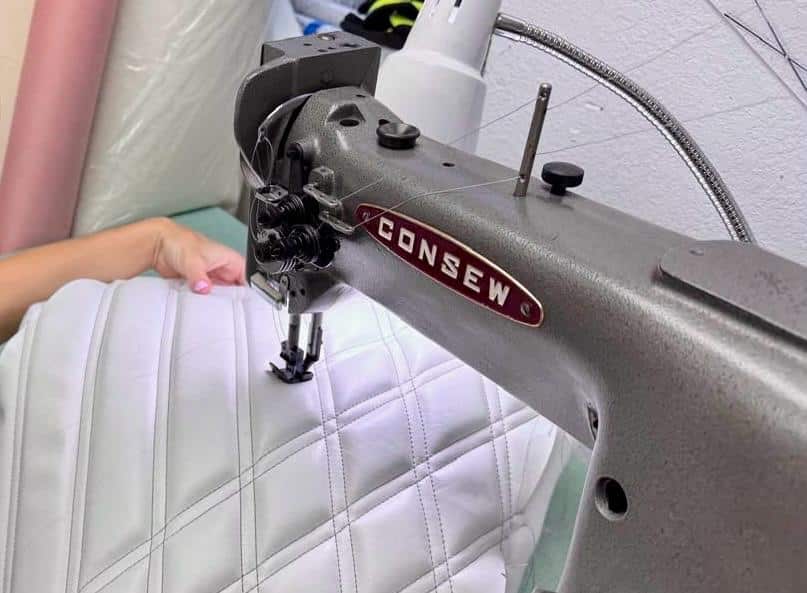
If you want the seat to look like something that belongs on a boat — not a wrinkled, sagging cushion from a patio chair — you must sew your vinyl with a walking-foot industrial machine.
Not a home sewing machine.
Not a “heavy-duty” domestic model.
Not even a vintage cast-iron Singer.
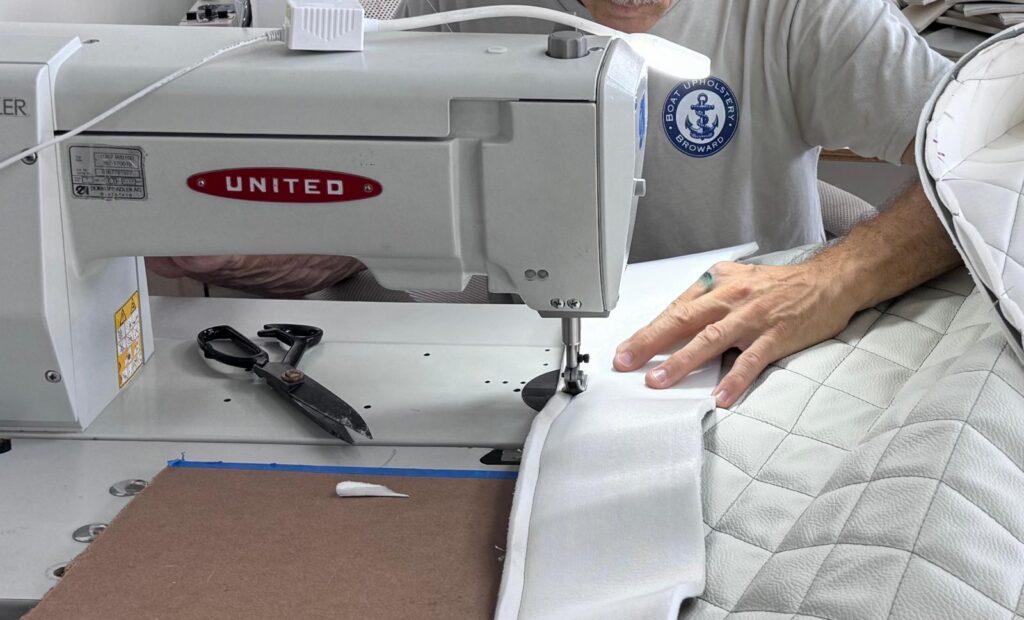
You need — and this is not optional — a proper industrial walking-foot machine.
Why?
Because marine vinyl is thick and slippery.
A normal machine drags the top layer faster than the bottom, stretching the vinyl, wrinkling the seams, and eventually causing the stitching to fail.
A walking-foot machine does the opposite: it pulls all layers forward evenly. That’s why professional seats look tight and clean.
And here’s the cost reality:
A proper walking-foot machine costs from $1,500 to $2,500+.
For many DIY enthusiasts, this is the moment they realize it might be cheaper — and definitely easier — to let a professional shop handle the job. That’s one reason so many Miami boat owners eventually call Boat Upholstery Broward after trying to figure out the sewing part.
Choosing the Right Materials (Marine-Grade Only)
If you’re determined to do this correctly, here’s what you’ll need:
- ½-inch marine plywood (regular plywood rots fast)
- High-density marine foam — usually 4” for seats, 2” for backrests
- 32-oz marine vinyl with UV protection
- Polyester batting for soft edges
- 138 bonded polyester thread (used in real marine upholstery)
- Stainless steel screws and staples
- 3M 90 spray adhesive
- Marine-grade sealant
Yes — this isn’t cheap. But cutting corners is the #1 reason DIY seats fall apart in a single season.
Building the Frame: The Easy Part (Mostly)
Many people assume building boat seats starts with foam. It doesn’t. It starts with the frame — and this is the part most DIYers can handle without trouble.
You cut your marine plywood, assemble the box, reinforce the corners, sand the edges, and seal everything with primer and exterior paint. This part is straightforward, even relaxing.
But don’t let the early progress fool you.
The difficult part comes next.
How to Make Seats for a Boat: Foam and Cushion Work
Foam decides everything. Comfort, shape, and even the look of the vinyl depend on foam.
When cutting foam:
- always make it slightly larger than the wood base
- use an electric carving knife (it cuts cleaner than anything else)
- glue layers carefully
- wrap the foam in polyester batting
This is where many beginners get their first surprise — the foam doesn’t magically look like a seat. It looks like a block. Getting it smooth and symmetrical takes time and patience.
Sewing Marine Vinyl (The Part That Makes People Quit DIY)
If there was one chapter of this guide responsible for turning DIYers into professional-shop customers, it would be this one.
Sewing vinyl is hard.
Sewing thick 32-oz marine vinyl is harder.
And sewing it into curved shapes with piping and symmetrical seams… that’s a different level entirely.
Even with a walking-foot machine, you must:
- mark the vinyl precisely
- sew long, straight seams
- sew curves evenly
- attach piping
- avoid puckering
- maintain consistent stitch tension
- work with stiff fabric that fights you at every turn
Imagine doing all of that on a household sewing machine.
That’s why so many people, after researching how to make boat seat or making a boat seat, eventually realize that professional upholstery shops exist for a reason.
Installing the Vinyl onto the Seat (Slow, Careful, and Hand-Destroying)
Here’s the truth: wrapping vinyl is physically tiring.
You stretch, pull, staple, reposition, refit, and stretch again.
A good seat requires:
- perfect tension
- clean corners
- wrinkle-free surfaces
- no staples pulling through
- and no loose areas that look baggy
Even professionals sometimes redo corners several times to get them perfect.
Beginners often struggle here for hours.
DIY Back-to-Back Boat Seats: Advanced Level Only
Among all DIY projects, diy back to back boat seats are the toughest.
Both sides must match perfectly.
Both backrests must align.
Foam must be shaped identically.
The hinges must be precise.
Unless you’ve built at least a few simpler boat seats already, this is not a good beginner project.
DIY Mistakes Most People Make (And Regret Later)
People who fail halfway usually fail here:
- using household plywood
- sewing vinyl with the wrong machine
- not sealing the wood
- cutting vinyl too small
- buying cheap foam
- ignoring stainless hardware
- not knowing how much the sun expands vinyl
These mistakes are so common that even reading this list saves you time and money.
Should You DIY, or Hire a Professional Marine Upholstery Shop?
This is the question everyone eventually asks.
If you:
- have a garage
- have a lot of time
- enjoy precision work
- love learning new skills
- and don’t mind buying specialized tools
→ DIY can be a fun and rewarding project.
But if you want:
- factory-quality seams
- perfectly shaped foam
- heat-resistant durable materials
- machine-wrapped corners
- long-lasting stitching
- a professional finish within a week
Then it’s worth reaching out to a specialist.
That’s why many boat owners in Miami end up calling Boat Upholstery Broward, and owners in northern Broward choose Boat Upholstery Fort Lauderdale.
For them, it’s easier to drop off the cushions and come back to flawless results.
DIY vs Professional Boat Seats — What’s Really Different?
| What You’re Comparing | DIY Approach | Professional Shop (Miami / Fort Lauderdale) |
| Tools Needed | You’ll need saws, foam cutters, a pneumatic stapler, and a $1,500+ walking-foot sewing machine. | All tools are already included; industrial machines, cutting tables, heat-sealing equipment. |
| Time Required | Anywhere from several days to several weeks, depending on skills. | Usually 7–10 business days for full marine seating. |
| Appearance / Finish | Depends heavily on experience; seams may wrinkle or shift. | Factory-level finish, tight seams, symmetric curves, professional piping. |
| Cost | Materials alone can cost as much as a small shop job. | Higher upfront, but guaranteed results and professional durability. |
| Stress Level | High — expect trial, error, and redoing corners multiple times. | Near zero — drop off cushions, get them back looking brand-new. |
FAQ — Common Questions About DIY Boat Seats
Do I really need a walking-foot sewing machine?
If you want your vinyl to look flat, tight, and clean — yes.
A regular sewing machine will fight you the whole time. It stretches vinyl unevenly, causes puckering, breaks needles, and leaves weak seams. A walking-foot machine moves all layers forward at the same pace, which is why professional seats never wrinkle.
The only downside is the price: $1,500–$2,500+.
How long do DIY boat seats last?
If you use real marine foam, marine vinyl, stainless hardware, and seal the wood properly, your DIY seats can last 6–10 years.
But if you cut corners anywhere — especially with foam, plywood, or thread — the lifespan drops dramatically to 1–3 years. Heat, humidity, and salt are unforgiving.
Can I use regular plywood to save money?
Only if you want the seat to rot from the inside within a season or two.
Regular plywood absorbs moisture fast, even when painted. Marine plywood is expensive because it’s designed to survive constant humidity and temperature changes without delaminating.
Is sewing really the hardest part?
Yes — for almost everyone.
Cutting wood is simple. Installing foam is manageable. But sewing thick vinyl with piping and curves requires skill, patience, and the right machine.
Even professionals sometimes redo corners multiple times to get them perfect.
What if I start a DIY project and get stuck?
Happens all the time.
Many boat owners begin searching for diy boat seat ideas, buy materials, cut the plywood — and then realize the sewing part is beyond their tools or comfort level.
If that happens, you can absolutely bring your partially finished project to a shop like Boat Upholstery Broward or Boat Upholstery Fort Lauderdale. They finish or redo the parts you’re struggling with.
Is DIY cheaper than hiring a shop?
Only if you already own the tools — especially the sewing machine.
Once you buy foam, vinyl, marine plywood, adhesives, batting, staples, and tools, the cost difference shrinks fast.
For many people, hiring a professional ends up being faster, easier, and ultimately not that much more expensive.
Conclusion: DIY is Possible — But Not Always Practical
Yes, you can make boat seats yourself.
Yes, you can build the frame, cut the foam, sew the vinyl, and install everything.
Thousands of people have done it before.
But it takes:
- time
- tools
- patience
- workspace
- and a professional-grade sewing machine
Most boat owners simply want to spend their weekends on the water — not fighting with marine vinyl in their garage.
If that sounds like you, then letting a professional handle the job is not only easier — it’s often cheaper, faster, and yields better results.
