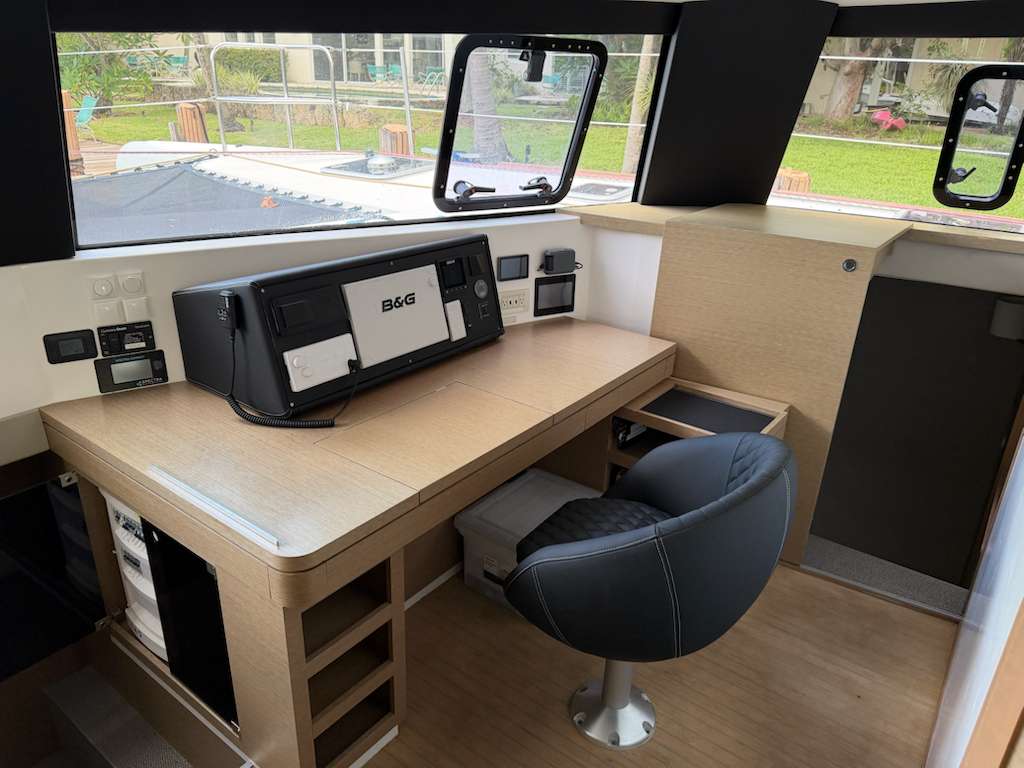
This catamaran helm seat repair and reupholstery project involved reconnecting a detached back to its base and replacing the old light-colored covering with dark vinyl and diamond stitching. The chair belongs to a large sailing catamaran docked on a canal in Fort Lauderdale, near Las Olas Boulevard. The photographs follow the chair from its original condition through the work on its structure and upholstery to the finished installation at the navigation desk.
Boat Upholstery Broward carried out both the chair work and the upholstery of the nearby instrument housing. They were parts of the same interior project, but each presented a different fitting problem. Here, the rounded back and its connection to the base needed attention before the new cover could give the chair its finished shape.
The Original Chair and Its Rounded Shape
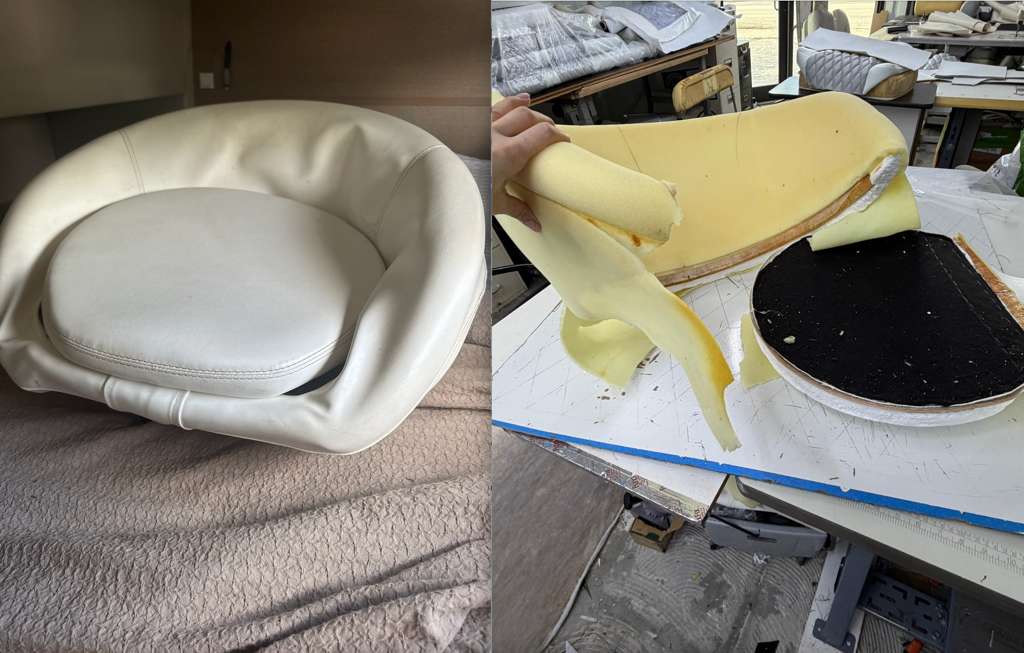
The original upholstery was pale and plain, with a separate seat cushion sitting inside a continuous curved back and sides. Visible folds appeared around the upper back and lower front edge. Looking at the cushion alone would miss much of the job: the surrounding upholstered shell is a substantial part of this chair.
When we opened the chair, the curved rigid-foam back had separated from the plastic base. The old polyurethane adhesive joint had broken down. This was more than a loose outer covering: the back and base needed to be reconnected before the chair could be reupholstered. The stripped components on the table show the shape beneath the original cover.
Reconnecting the Curved Back to the Base
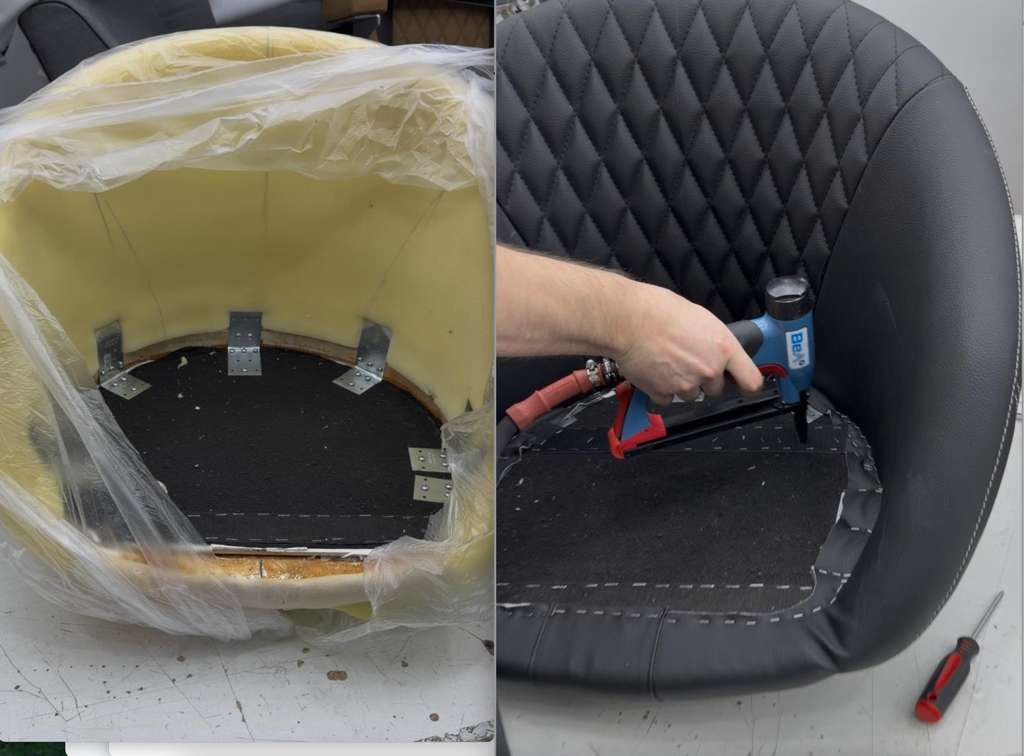
For this catamaran helm seat repair and reupholstery project, we selected stainless steel brackets and bent them to suit the connection between the back and base. We aligned the holes and fixed the brackets with stainless steel screws to a plate found inside the back. The brackets linked the curved back to the base rather than relying on the old adhesive joint.
The open-chair photograph shows the metal brackets around the lower inner structure. After making the connection, we covered the fastenings and added a separate layer of soft upholstery foam for comfort. That soft padding served a different purpose from the rigid foam forming the back: one cushions the upholstered surface, while the other forms the underlying curved shape.
Morbern Prodigy Black with Diamond Stitching
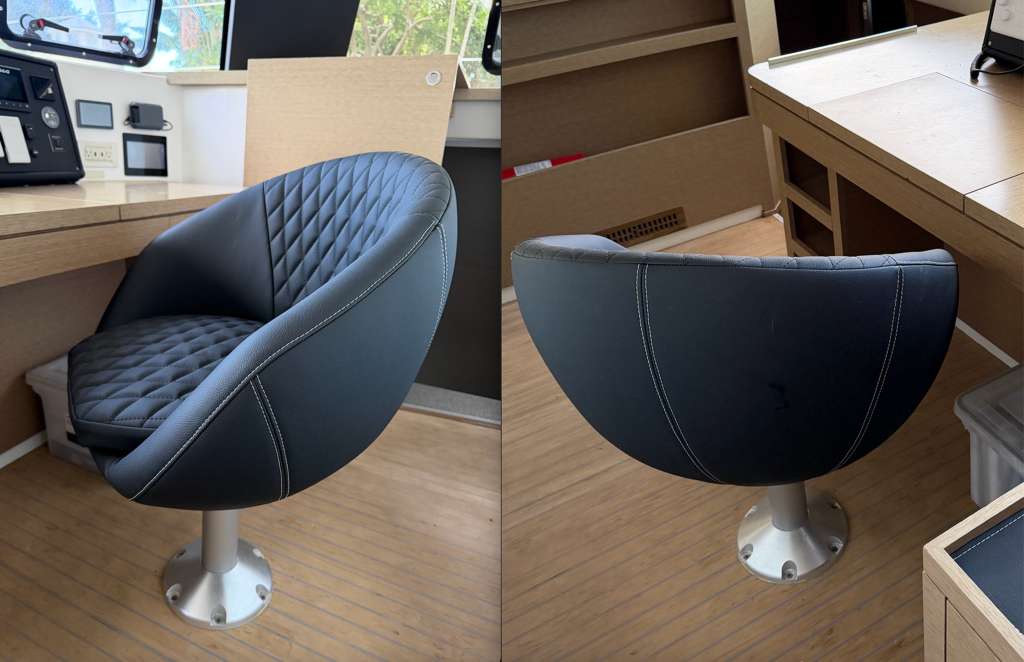
We sewed and fitted the new covering in Morbern Prodigy Black, using the same thread color as on the instrument housing. The diamond pattern runs across the inner back and round seat cushion. The curved outer sections remain plain, with light-colored stitching defining their shaped panels. Seen from the rear, the chair has a simpler finish; from the front, the quilted sections provide the decorative detail.
The assembly photograph shows the new upholstery being secured around the lower structure with a pneumatic stapler. At this stage, the seat cushion is out of the way, leaving the attachment area visible. Once assembled, the round cushion covers that area. The covering follows the back and sides, while the contrast stitching makes the panel boundaries easy to see.
catamaran helm seat repair and reupholstery: The Result
The finished chair is shown from both front and rear, installed on its stationary pedestal. The separate cushion sits within the curved sides, and the contrasting seams remain visible around the outer panels. These angles document the completed chair, including the plain outer back that is easy to overlook in a front-only photograph.
The final overall photograph places the chair beside the wooden navigation desk and instrument housing. The housing was another part of this project, covered in our separate catamaran dashboard reupholstery case. That article explains the restricted access around the connected equipment; this case documents the chair’s upholstery work.
Planning a Similar Captain’s Chair Project
To discuss catamaran helm seat repair and reupholstery, send views of the whole chair as well as close-ups of the covering. Useful photographs include:
- The front, rear, and both sides.
- The separate seat cushion and its edges.
- Any loose covering, damaged seams, or exposed padding.
- The chair in position beside the navigation desk.
Include the design details you want to retain or change, such as color, diamond stitching, and contrasting seams. A complete set of views helps distinguish a cushion-only request from reupholstering the surrounding chair as well. The photograph below shows why that wider perspective matters: the finished seat is part of an interior, not an isolated upholstery sample.