
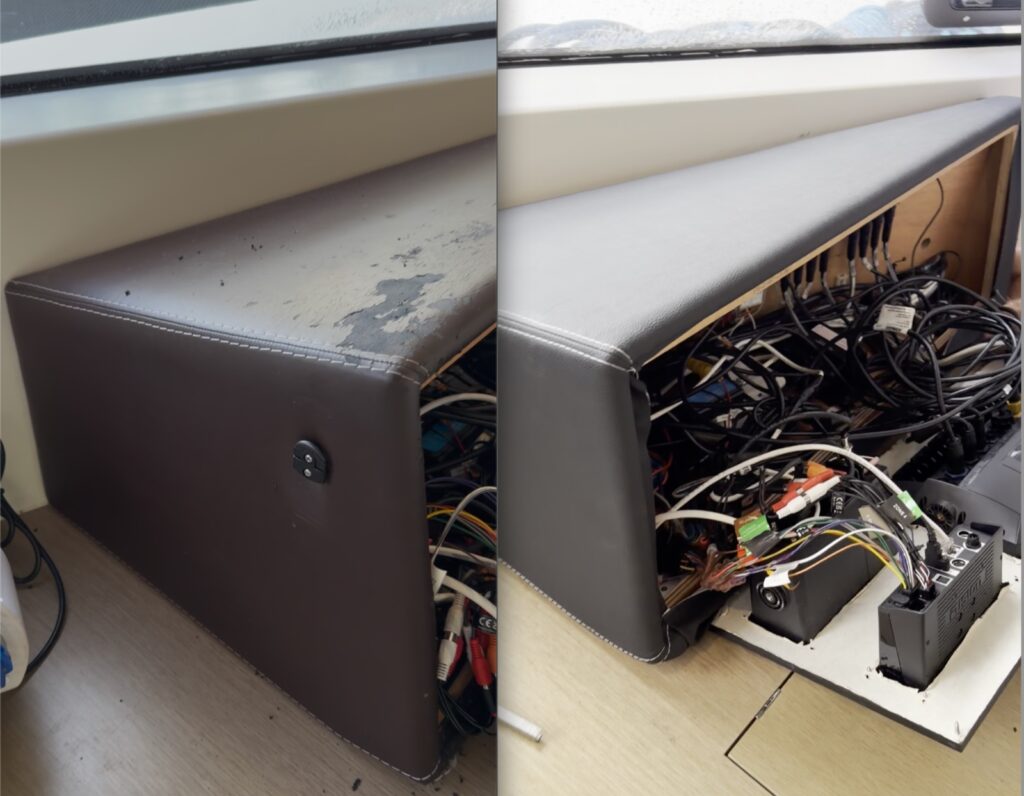
This catamaran dashboard reupholstery project took place aboard a large sailing catamaran docked at a waterfront home on a canal in Fort Lauderdale, near Las Olas Boulevard. We replaced the vinyl on the rectangular housing around the navigation instruments. The old surface was peeling, with areas of deterioration clearly visible beneath the window. The main challenge, however, was hidden behind the instruments: the housing could not simply be removed, taken to the workshop, and reupholstered with unrestricted access.
A dense bundle of wiring connected it to the catamaran’s systems. Those connections had to remain intact, and the available cable length allowed the housing to lift only a few millimeters above the desk. Boat Upholstery Broward therefore carried out this catamaran dashboard reupholstery in place, working around that limited access.

Preparing the Instrument Panel Surround
The work photographs show the instrument area open, exposing the wiring behind the front section. Our task was to reupholster the instrument panel surround—the covered housing supporting the equipment. It did not involve repairing the navigation instruments or electronics.
Before sewing, we needed to calculate the cover’s dimensions and how it would fit over the housing. A fully removed component can be turned and approached from different sides while the material is positioned. Here, the housing remained on the desk, connected to the catamaran’s systems.
Several details had to be considered together:
- The dimensions of the top and side surfaces.
- The positions of the corners and edges.
- The placement of the light-colored decorative stitching.
- The tension needed to fit the vinyl within the available working space.
These were connected decisions. The cover had to fit the housing, but it also had to settle into position with the stitching aligned along the intended edges and the vinyl lying smoothly.

Choosing Morbern Prodigy Black
For this housing, we used Morbern Prodigy vinyl in Black. Light-colored decorative stitching outlined the dark surface and emphasized the component’s shape. That contrast also made seam placement particularly important: the stitching needed to align with the corners and transitions rather than drift across a flat surface.
Material selection and fitting had to work together. We calculated the sewn cover’s dimensions with its final tension in mind, so the vinyl would follow the top and sides without wrinkles. The aim was a smooth fit that preserved the position of the decorative stitching once the cover was in place.
Why the One-Piece Cover Needed an Adjustment
The complete sewn cover could not be slipped over the fixed housing. The wiring and minimal clearance prevented us from handling it as a freely removable component. Keeping all existing connections intact remained a requirement throughout the work.
The solution was to make a partial cut in the cover, then draw it together at the rear while distributing tension around the housing. This allowed the upholstery to be fitted with the component still in its existing position. The vinyl needed to sit smoothly while the light-colored stitching remained aligned with the corners and edges.

Our team described the job as a mathematical puzzle. The cover dimensions, fit, and installation method could not be worked out independently: they all had to come together around a housing that could barely be lifted from the desk.
The Result: A New Finish Around the Existing Instruments
The comparison photographs show the change from peeling upholstery to a smooth, dark vinyl surface with light-colored stitching following the edge. One photograph captures the newly covered housing while the instrument area is still open. The wider view shows it back in the navigation station with the instruments in place.
The defining part of this catamaran dashboard reupholstery project was the restricted access. We fitted the new covering around a rectangular housing with very little room to move it, while preserving the existing connections. That constraint shaped both the cover’s construction and the way its tension was distributed during fitting.

Planning Your Catamaran Dashboard Reupholstery
To discuss a similar project, send an overall photograph of the navigation station and several close-ups of the damaged covering. Include views showing how the housing sits against the desk, window, and surrounding panels. If you know whether it can be removed or must remain connected to the equipment, include that information too.
Those photographs help explain both the upholstery condition and the access available for the work. In this project, access was the deciding factor: a seemingly straightforward rectangular housing required precise planning and a fitting solution tailored to its position.